Hey Readers,
Sorry I haven't posted for a while, I've been working about a zillion hours a day on an academic paper I'm getting published at a conference in April (I'm a PhD student in physics). I've not been home from work before 10pm for a couple of weeks, so obviously sleep is a priority over developing photos and writing about them, as I have to be up for 8 the next day. Hope to be able to update soon,
Best regards, and thank you for reading,
Matthew
Tuesday, 15 March 2011

Tuesday, 25 January 2011
Glass Plate Negative
In the Big Bag Of Goodies I bought at the weekend, there was a box labelled "Agfa Isopan ISS" and an expiry date of September 1939, which is when WWII kicked off. When I opened the box, I found not Isopan ISS, but a single glass plate negative of a landscape. I scanned it in using my 4990 and was absolutely astonished by the detail. The exposure is spot on, and some sort of filter has been used (or the spectral response was weird, which is also possible) so I think it's been taken by someone who knows what they were doing.
It's a tiny plate, I believe 2 1/2 by 3 1/3 inches in size, with fairly rough edges, so it may have been cut by the photographer from a larger plate- that's just my conjecture though.
Anywho, enough talking, here's the picture. If you feel like editing the levels/curves to give a punchier image, just let me know and I'll send you a high-res TIFF file. I'm not that great with PS etc., so I'd love to see what can be done with this. The image contains so much detail and isn't blocked up in either highlights or shadows, I'm sure something fantastic could be done with it.
I might even make you a lumen print as reward, if you do something nice.

If you want to see it larger, look here.
Oh, and if you have any idea where this is, tell me!
It's a tiny plate, I believe 2 1/2 by 3 1/3 inches in size, with fairly rough edges, so it may have been cut by the photographer from a larger plate- that's just my conjecture though.
Anywho, enough talking, here's the picture. If you feel like editing the levels/curves to give a punchier image, just let me know and I'll send you a high-res TIFF file. I'm not that great with PS etc., so I'd love to see what can be done with this. The image contains so much detail and isn't blocked up in either highlights or shadows, I'm sure something fantastic could be done with it.
I might even make you a lumen print as reward, if you do something nice.
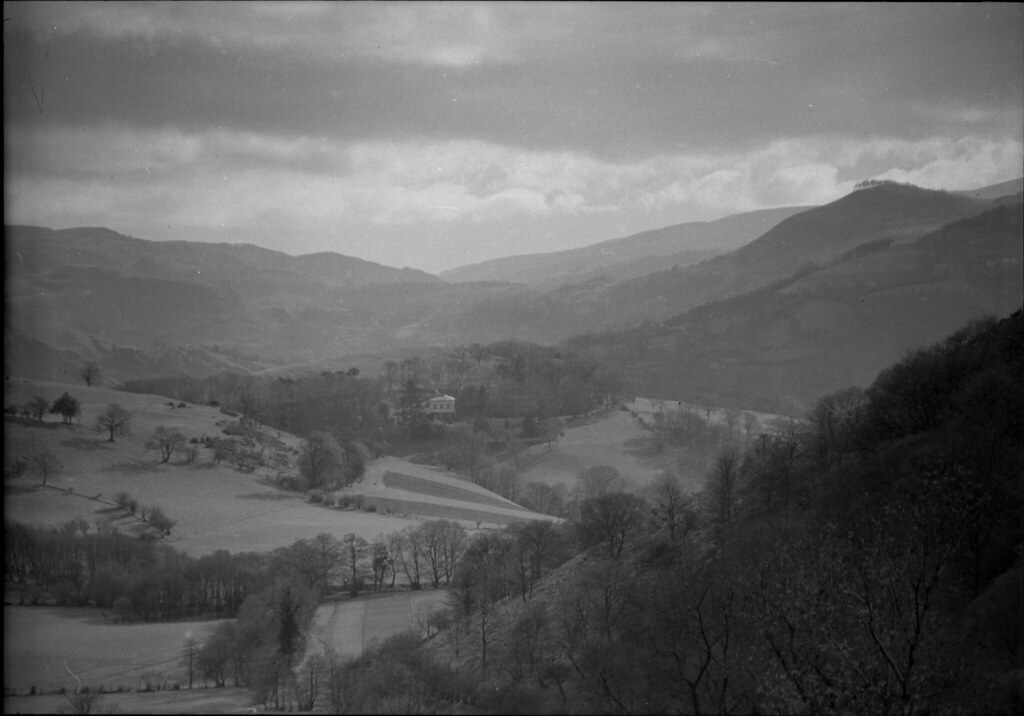
If you want to see it larger, look here.
Oh, and if you have any idea where this is, tell me!
Monday, 24 January 2011
Lumen Prints
I bought two carrier bags full of very old (at a guess 1960s) photo paper (and some other goodies) at Tynemouth flea market this weekend (Jan 22/23 2011) and since I needed to look at a sheet from each box to see if it had been exposed, I decided to make some Lumen prints. Some are plants, some are prints from film negatives.
The recipe I used for this was:
0) Get your paper out of the packet without exposing any of the rest of the paper. Use a dark bag/darkroom.
Everything else in daylight:
1) Put whatever you're using to make your photogram on top of the paper.
2) Put glass on top of that, if you can
3) Leave in sunlight until the paper gets dark (I used about 45 mins, but should probably have waited longer).
4) Fix in rapid fixer (this significantly lightens the image).
5) Wash in running water, then dry.

Here are more results:
All so far are done on old Kodak paper, which is no longer produced.
http://www.flickr.com/photos/msmoynihan/sets/72157625773448257/
The recipe I used for this was:
0) Get your paper out of the packet without exposing any of the rest of the paper. Use a dark bag/darkroom.
Everything else in daylight:
1) Put whatever you're using to make your photogram on top of the paper.
2) Put glass on top of that, if you can
3) Leave in sunlight until the paper gets dark (I used about 45 mins, but should probably have waited longer).
4) Fix in rapid fixer (this significantly lightens the image).
5) Wash in running water, then dry.
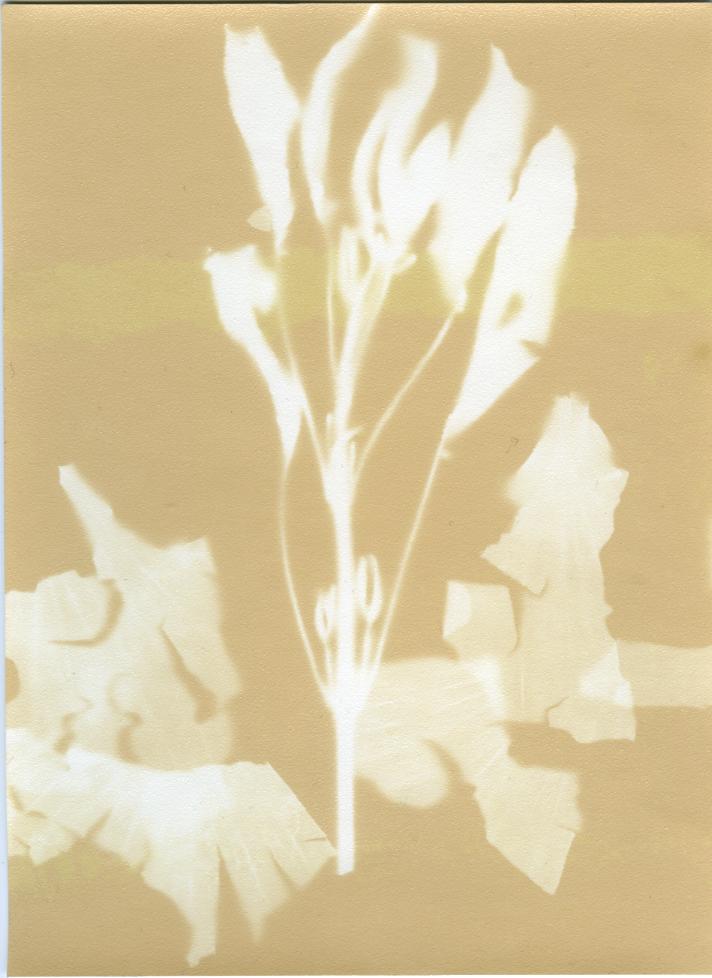
Sage and Onion, Lumen Print, 23rd Jan 2010, Kodak Bromesko
Here are more results:
All so far are done on old Kodak paper, which is no longer produced.
http://www.flickr.com/photos/msmoynihan/sets/72157625773448257/
Thursday, 20 January 2011
50 years old
On the 1st of August 2009, I loaded into my Duaflex II a roll of 620 Tri-X. The reason I mention that it was in August 2009 was that I'd specifically chosen that date. The date was chosen because the roll had expired in August 1959, making the film exactly 50 years out of date.
I shot the film whilst visiting my grandparents, whilst at my parents' home, whilst on holiday in Spain, and in Northumberland, around Lindisfarne.
I didn't get round to developing the film, for a while, and during that time my grandfather passed away, leaving the latent image of him still on the undeveloped film, like a ghost.
I wasn't sure whether I'd get any images at all, and was scared that I'd ruin the precious ghost by developing wrongly.
The other day, I eventually decided that enough was enough. I'd waited long enough to develop this roll (about 18 months) and that I was going to do it. Any development of film this old was going to be a guess, so I took the time on the TMax developer bottle for new TX, and added a bit more, for luck.
I developed for 7:30, agitating continually for the first 30s, then for 5s every 30s thereafter.
I fixed and washed the film, before finally putting in the wetting agent for the final rinse.
I pulled the reel from the tank, glistening, wet.
There was a moment, my heart in my mouth, where I thought that the old film was blank. I couldn't see anything but fog and wet film. But then! I noticed an image, on the outside of the reel. It was the image I'd worried about so much, and been so desperate to salvage. At that point, I would have been happy if the rest of the roll had been destroyed by bacteria or age, but as I gently pulled the tacky film from the reel, I could see more and more faint, blotchy images appearing; boats, castles, seasides. I was in luck.
I hung the negative to dry from a coathanger in my bathroom, my breath baited in case the old images decided to fade, as sometimes they do.
As soon as the film was no-longer dripping (but the emulsion was still tacky), I got that first image into the scanner, and saw my ghost, as clear as, well, a foggy day.
 Once I'd scanned that image, I hung the film up again, to dry properly overnight. I had a record of my image, and I was happy.
Here is a link to the rest of the images. I hope you like them.
http://www.flickr.com/photos/msmoynihan/sets/72157625740561427/
I shot the film whilst visiting my grandparents, whilst at my parents' home, whilst on holiday in Spain, and in Northumberland, around Lindisfarne.
I didn't get round to developing the film, for a while, and during that time my grandfather passed away, leaving the latent image of him still on the undeveloped film, like a ghost.
I wasn't sure whether I'd get any images at all, and was scared that I'd ruin the precious ghost by developing wrongly.
The other day, I eventually decided that enough was enough. I'd waited long enough to develop this roll (about 18 months) and that I was going to do it. Any development of film this old was going to be a guess, so I took the time on the TMax developer bottle for new TX, and added a bit more, for luck.
I developed for 7:30, agitating continually for the first 30s, then for 5s every 30s thereafter.
I fixed and washed the film, before finally putting in the wetting agent for the final rinse.
I pulled the reel from the tank, glistening, wet.
There was a moment, my heart in my mouth, where I thought that the old film was blank. I couldn't see anything but fog and wet film. But then! I noticed an image, on the outside of the reel. It was the image I'd worried about so much, and been so desperate to salvage. At that point, I would have been happy if the rest of the roll had been destroyed by bacteria or age, but as I gently pulled the tacky film from the reel, I could see more and more faint, blotchy images appearing; boats, castles, seasides. I was in luck.
I hung the negative to dry from a coathanger in my bathroom, my breath baited in case the old images decided to fade, as sometimes they do.
As soon as the film was no-longer dripping (but the emulsion was still tacky), I got that first image into the scanner, and saw my ghost, as clear as, well, a foggy day.
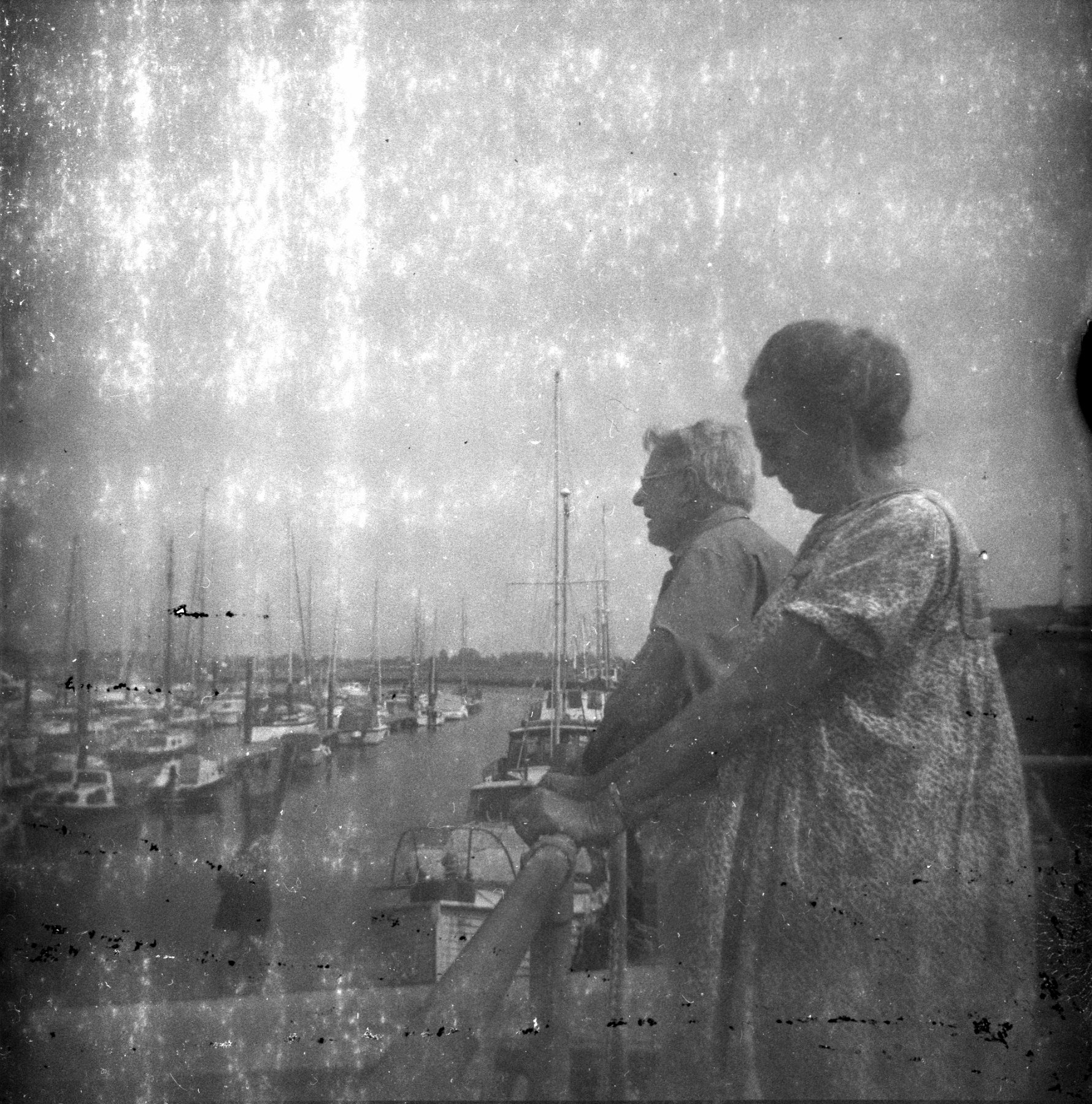
Here is a link to the rest of the images. I hope you like them.
http://www.flickr.com/photos/msmoynihan/sets/72157625740561427/
Sunday, 16 January 2011
Prinzpan (FP3 or 4) expired May 1970
Hallo, I shot some Prinzpan 120 film in the summer in my Yashicamat-124G.
The film is, as far as I can tell, rebranded FP3 or FP4. Its expiry date is May 1970, which is around the time of the changeover from FP3 to FP4, so I suspect that it might have been old FP3 stock sold off cheaper through DIxons (a British high-street electronics retailer).
Anywho, I exposed at 125 (I think, I might have been a little more generous with exposure, but not a lot), and decided not to send the film off in the envelope that was included with it for development at the bargain-basement cost of 6p (about 10c in American terms) because I suspected that the address might be dead by now, 40 years later.
I souped it the other night in Rodinal 1+50 for 17:30, agitating continually for the first 30s, then 10s once every minute.
I extended a bit from an FP4+ time of 15:00, to account for the age of the film and possible fogging, but I think that actually 15:00 might have been spot-on, as there was virtually no fog, and the negs came out a little bit contrasty.
Anywho, here are my images, in case you're interested as to what this funny old film can achieve.
The film is, as far as I can tell, rebranded FP3 or FP4. Its expiry date is May 1970, which is around the time of the changeover from FP3 to FP4, so I suspect that it might have been old FP3 stock sold off cheaper through DIxons (a British high-street electronics retailer).
Anywho, I exposed at 125 (I think, I might have been a little more generous with exposure, but not a lot), and decided not to send the film off in the envelope that was included with it for development at the bargain-basement cost of 6p (about 10c in American terms) because I suspected that the address might be dead by now, 40 years later.
I souped it the other night in Rodinal 1+50 for 17:30, agitating continually for the first 30s, then 10s once every minute.
I extended a bit from an FP4+ time of 15:00, to account for the age of the film and possible fogging, but I think that actually 15:00 might have been spot-on, as there was virtually no fog, and the negs came out a little bit contrasty.
Anywho, here are my images, in case you're interested as to what this funny old film can achieve.

Right!
There we go. I've rescued all the posts that Google cache has still got in its archives. There's quite a lot of content there, and it's all unordered because I just posted it as I found it. Next for a real post!
ISOPAN F - UPDATE
Originally posted SUNDAY, 14 FEBRUARY 2010
ISOPAN F - UPDATE
I've finally uploaded the whole reel of Isopan F onto Flickr, thanks to my brother's birthday present to me- pro membership (and hence more upload capacity). If you want to take a look, check out:
http://www.flickr.com/photos/msmoynihan/sets/72157623310828153/
Please, if that link doesn't work, LEAVE A COMMENT so that I can fix it!
Hope it's of interest to someone!
http://www.flickr.com/photos/msmoynihan/sets/72157623310828153/
Please, if that link doesn't work, LEAVE A COMMENT so that I can fix it!
Hope it's of interest to someone!
Subscribe to:
Posts (Atom)