Monday, 24 January 2011

Lumen Prints

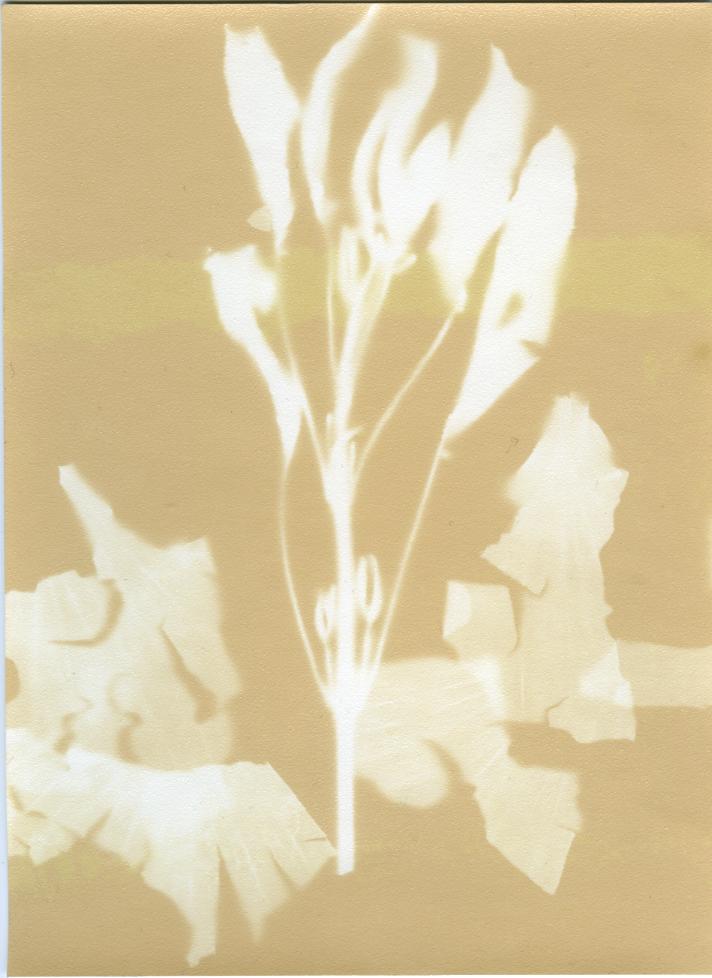
bought two carrier bags full of very old (at a guess 1960s) photo paper (and some other goodies) at Tynemouth flea market this weekend (Jan 22/23 2011) and since I needed to look at a sheet from each box to see if it had been exposed, I decided to make some Lumen prints. Some are plants, some are prints from film negatives.
The recipe I used for this was:
0) Get your paper out of the packet without exposing any of the rest of the paper. Use a dark bag/darkroom.
Everything else in daylight:
1) Put whatever you're using to make your photogram on top of the paper.
2) Put glass on top of that, if you can
3) Leave in sunlight until the paper gets dark (I used about 45 mins, but should probably have waited longer).
4) Fix in rapid fixer (this significantly lightens the image).
5) Wash in running water, then dry.


Sage and Onion, Lumen Print, 23rd Jan 2010, Kodak Bromesko


Here are more results:
All so far are done on old Kodak paper, which is no longer produced.
http://www.flickr.com/photos/msmoynihan/sets/72157625773448257/

Thursday, 20 January 2011

50 years old

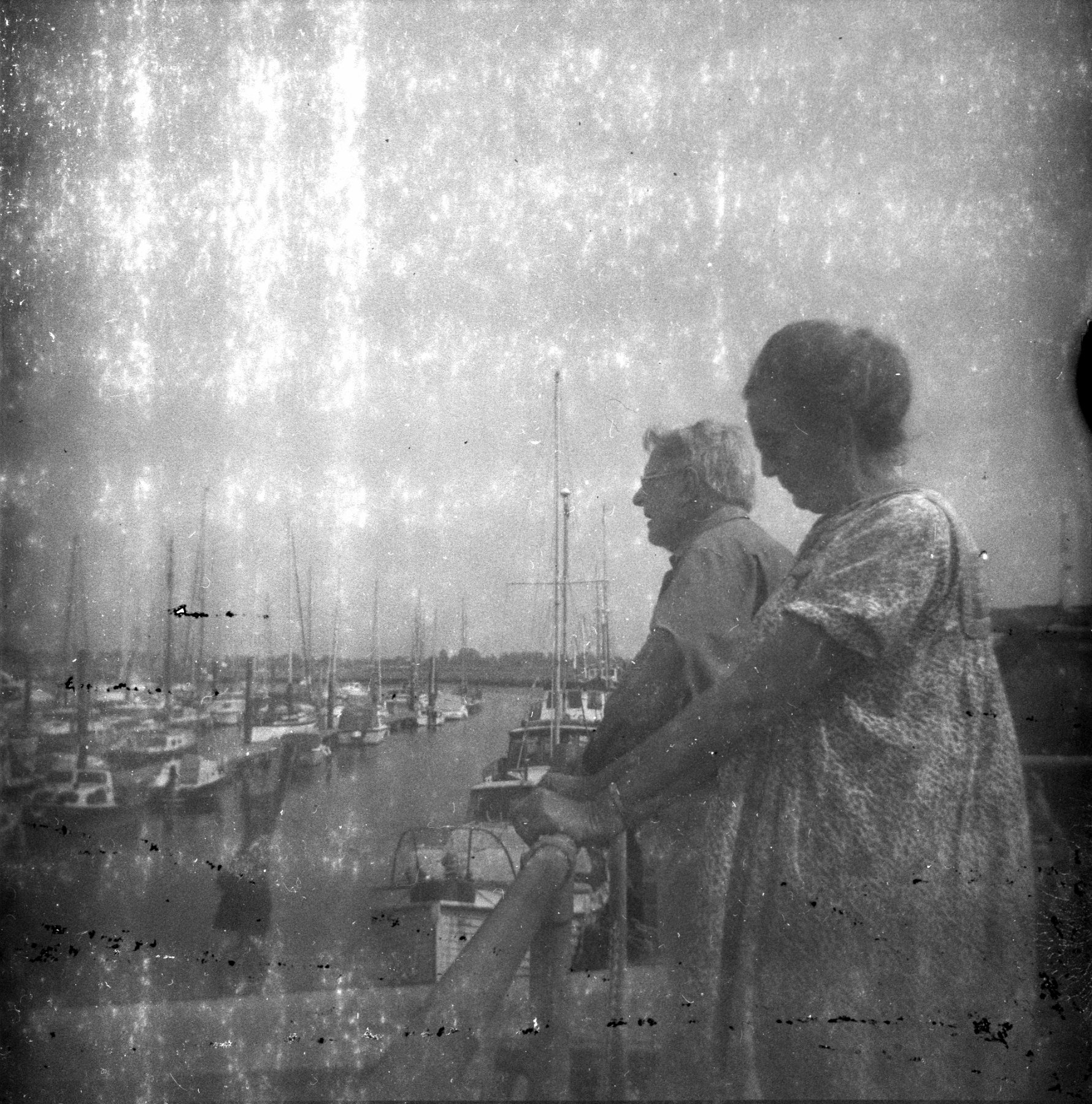
On the 1st of August 2009, I loaded into my Duaflex II a roll of 620 Tri-X. The reason I mention that it was in August 2009 was that I'd specifically chosen that date. The date was chosen because the roll had expired in August 1959, making the film exactly 50 years out of date.
I shot the film whilst visiting my grandparents, whilst at my parents' home, whilst on holiday in Spain, and in Northumberland, around Lindisfarne.
I didn't get round to developing the film, for a while, and during that time my grandfather passed away, leaving the latent image of him still on the undeveloped film, like a ghost.
I wasn't sure whether I'd get any images at all, and was scared that I'd ruin the precious ghost by developing wrongly.
The other day, I eventually decided that enough was enough. I'd waited long enough to develop this roll (about 18 months) and that I was going to do it. Any development of film this old was going to be a guess, so I took the time on the TMax developer bottle for new TX, and added a bit more, for luck.
I developed for 7:30, agitating continually for the first 30s, then for 5s every 30s thereafter.
I fixed and washed the film, before finally putting in the wetting agent for the final rinse.
I pulled the reel from the tank, glistening, wet.
There was a moment, my heart in my mouth, where I thought that the old film was blank. I couldn't see anything but fog and wet film. But then! I noticed an image, on the outside of the reel. It was the image I'd worried about so much, and been so desperate to salvage. At that point, I would have been happy if the rest of the roll had been destroyed by bacteria or age, but as I gently pulled the tacky film from the reel, I could see more and more faint, blotchy images appearing; boats, castles, seasides. I was in luck.
I hung the negative to dry from a coathanger in my bathroom, my breath baited in case the old images decided to fade, as sometimes they do.
As soon as the film was no-longer dripping (but the emulsion was still tacky), I got that first image into the scanner, and saw my ghost, as clear as, well, a foggy day.
Once I'd scanned that image, I hung the film up again, to dry properly overnight. I had a record of my image, and I was happy.
Here is a link to the rest of the images. I hope you like them.
http://www.flickr.com/photos/msmoynihan/sets/72157625740561427/

Sunday, 16 January 2011

Prinzpan (FP3 or 4) expired May 1970

Hallo, I shot some Prinzpan 120 film in the summer in my Yashicamat-124G.
The film is, as far as I can tell, rebranded FP3 or FP4. Its expiry date is May 1970, which is around the time of the changeover from FP3 to FP4, so I suspect that it might have been old FP3 stock sold off cheaper through DIxons (a British high-street electronics retailer).
Anywho, I exposed at 125 (I think, I might have been a little more generous with exposure, but not a lot), and decided not to send the film off in the envelope that was included with it for development at the bargain-basement cost of 6p (about 10c in American terms) because I suspected that the address might be dead by now, 40 years later.
I souped it the other night in Rodinal 1+50 for 17:30, agitating continually for the first 30s, then 10s once every minute.
I extended a bit from an FP4+ time of 15:00, to account for the age of the film and possible fogging, but I think that actually 15:00 might have been spot-on, as there was virtually no fog, and the negs came out a little bit contrasty.
Anywho, here are my images, in case you're interested as to what this funny old film can achieve.

Right!

There we go. I've rescued all the posts that Google cache has still got in its archives. There's quite a lot of content there, and it's all unordered because I just posted it as I found it. Next for a real post!

ISOPAN F - UPDATE

Originally posted SUNDAY, 14 FEBRUARY 2010

ISOPAN F - UPDATE

I've finally uploaded the whole reel of Isopan F onto Flickr, thanks to my brother's birthday present to me- pro membership (and hence more upload capacity). If you want to take a look, check out:
http://www.flickr.com/photos/msmoynihan/sets/72157623310828153/
Please, if that link doesn't work, LEAVE A COMMENT so that I can fix it!
Hope it's of interest to someone!

Beier Beirette Junior 2

ORIGINALLY POSTED THURSDAY, 23 JULY 2009

Beier Beirette Junior 2


Picture from Camerapedia.
I would take my own, but my digital camera has died, I hope that the original photographer doesn't mind.
Decided to do a review of this little camera. I picked it up in a charity shop in Rayleigh for, IIRC, £5.50. I mainly bought it because it looks nice.

It's small, it's pretty and it comes in a neat little leather/plastic case, which despite being a never-ready case is actually pretty useful.

The lens on my Beirette is a slightly superior one to the one on the camera in the picture above. Mine is an E.Ludwig 45mm "Meritar" lens, which opens up to f/2.9, slightly wider than the f/3.5 above. It stops down to f/22. It will focus as close as 2 feet, with the DoF extending nearer than (~1') that if you stop down enough.

The shutter is a "Junior 2" with three speeds - 30, 60, 125 and a B setting. To be honest, how many more speeds do you actually need, unless you're shooting in bright sun with fast film?

The shutter has a double exposure lock, so that you can't expose the same frame twice. Unfortunately it's not infallible, especially if you don't wind the winder fully in one smooth go. That way you get three pictures over 2 frames, if you're unlucky. It has a cable-release socket as well, for if you want to take long exposures, or remotely trigger the shutter.

The view finder is absolutely minute, the window being about 3mm x 6mm. When I got mine, the tiny, weeny viewfinder was totally clouded, with what I assume must be cigarette tar. The camera doesn't smell of smoke, but I can't think what else would cause that discolouration which scratched off with a thumbnail quite easily. Unfortunately, the internal sides of the glass in the viewfinder also have this crap on them, which obviously I can't remove without dismantling the whole thing. I'm not that fussed really, I can see a sort of yellowed image through the viewfinder, and as everyone who's ever used any kind of camera that's not SLR will know, the viewfinder doesn't give much better than a good guess as to what's going to be in your picture.

Interestingly enough, the viewfinder does have two settings, one for "N" and the other for "". Where "infinity" ends and "near" begins, I have no idea, but it's fairly irrelevant since changing between modes makes little, if any, difference to what you can see through the viewfinder, except that in "infinity" mode, you can't see quite as much of the lens barrel in the corner of the view.

There's a flash cable socket on the lens barrel and a cold-shoe on the top. If I can get my old-style bulb-flash working, I might put it on this camera, because they're both pretty stylish.

The winder knob has a reminder dial on it with film speeds in DIN and types of film. In order to rewind the film, you have to push a little switch underneath the winder from "T" to "R" (whatever they might stand for), then lift up the winder and twist to unlock the advance mechanism. Another wheel on the LHS is for rewinding the film into the canister. If you pull up the LHS wheel there's two vertical pins. You can spin these around to bring the frame counter back to zero.

Talking of film, I should probably discuss loading this camera. Opening the back is a bit of a puzzle (well, maybe just for me). If you look at the picture of the camera at the top, there's a bar along the RHS of the camera, it looks like it might move up and down, or hinge out. It doesn't. You have to twist it laterally, so that the bottom comes towards you and the top moves away. This kind of prises the back off the camera, which isn't hinged and just comes off as a whole piece. This took me and several other people quite a while to work out. Once you finally are inside, there's a flappy pressure plate hinged to the inside of the camera. It's a bit weird, but there we go. Loading is pretty simple, as long as you make sure that the film goes under the flap, not over it, and that it engages the sprocket holes with the sprockets on the cog.

Anywho, it produces really nice pictures, sharp, as long as you guess the focussing distance accurately enough (UPDATE: It doesn't, see below). There's a DoF scale on the lens, so you can work out what'll be in focus at the aperture you've chosen. I ran a roll of chromogenic BW film through this because there's no meter and it has good latitude for those who have to guess their exposures. It's also pretty fast so it's OK to stop down a bit for more DoF. Will add some photos from it when I can find them, as I last used it about 6mths ago.

I've just found the pictures. It seems I'd confused my memory of a different camera's results. The pictures I got from this camera weren't great. Most of them were blurred, although I think this was more due to the badly placed shutter release than bad focussing. Pressing the shutter release basically jars the camera. Not great for keeping things blur-free. Even on small 6x4 prints it was obvious. There were several totally blank frames on the roll - I think this is probably more due to a lack of a meter, and optimistic light estimations rather than a shutter fault. There were about 2 crisp, sharp photos on the roll, but I think an 18:1 success rate is pretty low. If you could be bothered to carry a release cable with this camera, it might fare considerably better, but then it loses half its charm, of being small, stylish and easy to use.

Oh, it is a very quiet camera, so for those of you who worry about that sort of thing, it might be OK...
Kodak 5302 "Fine Grained Positive Release"

ORIGINALLY POSTED TUESDAY, 28 JULY 2009


Kodak 5302 "Fine Grained Positive Release"

I was given this in a film swap from a kindly flickrite named Chris Beauchemin, who had bought 100' of it and wasn't quite sure what he was going to do with ~800 exposures worth of incredibly slow film, only sensitive to blue and without an anti-halation backing. Despite its name, when you develop it, you get a negative. It can be used to make b/w slides by photographing other negatives, since the filmbase is clear once developed. Before development, it's an eerie white colour, a bit like glow in the dark plastic, but without the green phosphorescence.

 http://www.flickr.com/photos/msmoynihan/sets/72157623456848976/

In all of the pictures, the sky is plain white because it's actually blue and thus massively exposing the film, unlike everything else, which just reflects smaller amounts of blue from the sky.
Unfortunately, a few frames on this roll were ruined because I loaded the camera in sunshine (clever). The light piped down the film and fogged a few images. This is because there is no anti-halation layer to stop light piping. A similar thing occurs if you load Kodak's HIE in daylight, as that also lacks an AH layer.
Anywho, thanks Chris, it was great fun playing with something new.